


A Rare Mind: Remembering the Greatest Works of Frank Gehry Following His Passing at 96
- Otávio Santiago

- Dec 10
- 3 min read
A Legacy That Reshaped Architecture
Frank Gehry’s passing at 96 marks the end of one of the most transformative careers in contemporary architecture. Few figures have shifted the global imagination as profoundly as he did. With a sculptural vocabulary that pushed beyond conventional geometry, and a fearless embrace of materials like titanium, stainless steel, plywood, and glass, Gehry revolutionized not only how buildings look, but how they behave—how they interact with light, with cities, and with the emotional landscape of the people who encounter them.
Across more than six decades, Gehry developed a language that blurred the line between architecture and art. His works were not static constructions; they were movements frozen in time, choreographies of impossible curves and gravity-defying surfaces. Through this approach, he catalyzed urban renewal, reshaped cultural institutions, and redefined architectural ambition for generations to come. His legacy is best understood not through individual buildings, but through the cumulative impact of a career that consistently expanded the boundaries of what architecture could be.
Shifting Urban Futures Through Form and Vision
Among the Frank Gehry greatest works, the Guggenheim Museum Bilbao stands as a turning point—not only for Gehry, but for global urbanism. Its shimmering titanium forms and digitally conceived geometry demonstrated that architecture could alter the destiny of an entire city. The so-called “Bilbao Effect” became an international benchmark for cultural-led regeneration, proving that architecture can carry economic, social, and symbolic power on an unprecedented scale.

This commitment to architecture as civic catalyst continued throughout Gehry’s career. In Los Angeles, the Walt Disney Concert Hall emerged as a cultural anchor for the city, where its stainless-steel sails and acoustically optimized interior established a new standard for public performance spaces. Similarly, projects such as the Jay Pritzker Pavilion in Chicago explored how architecture could expand the collective experience of sound, gathering, and urban life.
Gehry’s work consistently engaged with the complexities of context. His Fondation Louis Vuitton in Paris floats through the Bois de Boulogne like a set of glass “sails,” embracing the surrounding landscape while pushing fabrication technologies to new limits. At the opposite end of the spectrum, the Gehry Residence in Santa Monica—an early manifesto wrapped in chain-link fencing and corrugated metal—challenged the conventions of domestic architecture and announced the arrival of a radical new voice.
Evolving Architectural Language and Material Experimentation

Across continents, Gehry reinvented his architectural vocabulary again and again. The Vitra Design Museum in Germany marked his early experimentation with intersecting forms and plastered geometric volumes, while the Dancing House in Prague demonstrated how movement could be encoded directly into the façade of an urban building. Later, Gehry brought this expressive sensibility into the vertical dimension with 8 Spruce Street in New York, where rippling stainless-steel panels animated the skyline and redefined what residential towers could express.
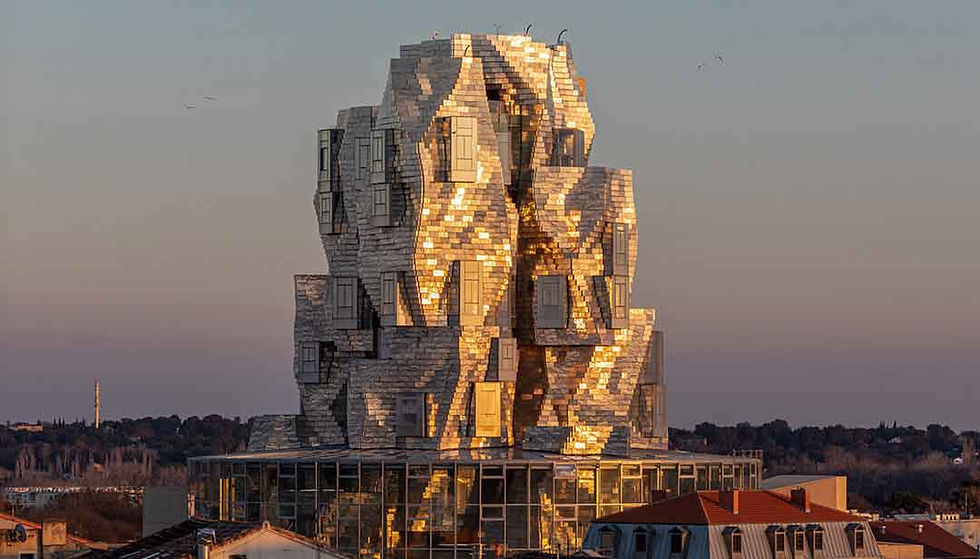
Even late in his career, Gehry continued to innovate. LUMA Arles, with its twisting, reflective skin of over 11,000 stainless-steel panels, stands as a testament to his persistent curiosity and refusal to settle into repetition. The project merges research, art, and urban renewal into a single sculptural landmark—one that continues Gehry’s lifelong commitment to architecture as both cultural engine and spatial experiment.
Throughout this evolution, his buildings remained anchored in a profound understanding of movement, light, and material behavior. Whether interpreting crushed guitars for Seattle’s MoPOP or capturing the shifting Midwestern sky on the Weisman Art Museum, Gehry treated surfaces as living entities—responsive, dynamic, and deeply expressive.
Frank Gehry - A Mind That Expanded the Limits of the Possible

To remember Frank Gehry is to remember the courage to defy gravity, convention, and expectation. His work fused emotional resonance with technological daring, and in doing so, altered the course of architectural history. Gehry showed the world that buildings could be both functional and fantastical—that they could shape identity, transform economies, and awaken the imagination of entire generations.
As the architectural world reflects on his passing, we find ourselves surrounded by the very evidence of his impact: cities revitalized, cultural institutions redefined, and skylines forever marked by the fluidity of his vision. The Frank Gehry greatest works are not just buildings; they are moments when architecture expanded its reach, becoming a poetic, civic, and cultural force.
His legacy endures, shimmering across titanium surfaces, bending through improbable curves, and echoing in the spaces where his imagination shifted the world.\

Written by Otávio Santiago, a designer dedicated to translating ideas into visual rhythm. His work spans motion, 3D, and graphic design — connecting creativity, technology, and human emotion.





Comments