


Doarchiwow Redefines Prefabricated Architecture with the Forest Nests Treepod Project in China
- Otávio Santiago
- 11 minutes ago
- 2 min read
Doarchiwow Redefines Prefabricated Architecture with the Forest Nests Treepod Project in China
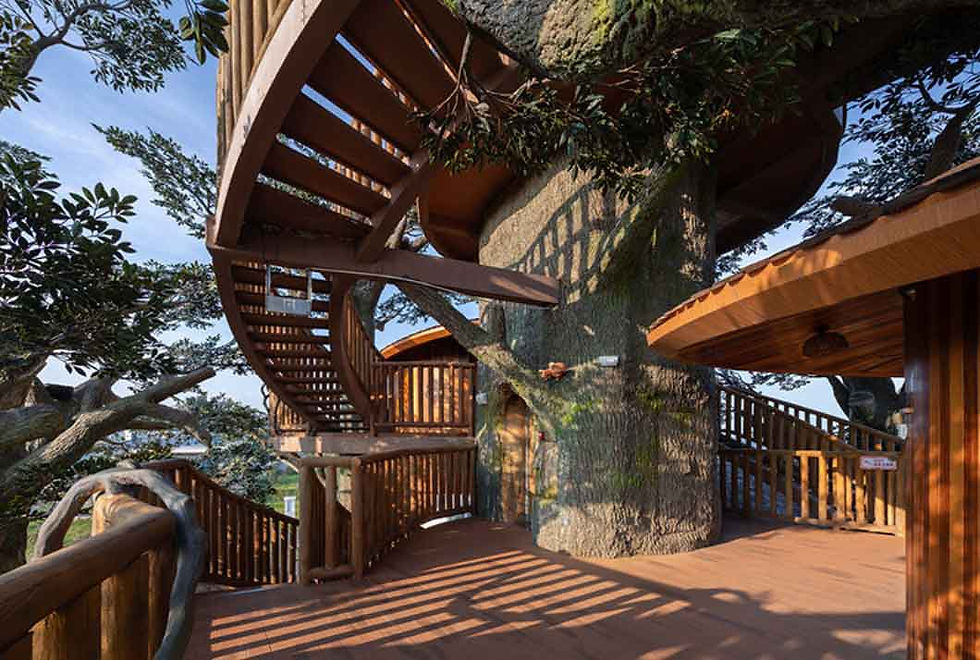
Doarchiwow’s Forest Nests Treepod Project introduces a new vision for modular ecological living — a design concept that functions simultaneously as a boutique resort prototype and a model for low-impact, near-zero-carbon construction. Developed for diverse sites across

China, including Rizhao and Wuhan, the series transforms the idea of a treehouse into a vertical, nature-embedded micro-community.
Drawing inspiration from bird nests, cocoons, and organic structures, Forest Nests uses biomimicry to inform a system of modular, fluid geometries. Each pod is built around a steel skeleton wrapped in wood shingles, weathering steel plates, aluminum cladding, and glass.
The result is a prefabricated structure that feels more grown than assembled — an architectural organism integrated seamlessly within forest, coastal, or urban environments.
Organic Forms Shaped Through Modular Logic

Forest Nests relies on digital fabrication and parametric design to translate its complex, curvilinear volumes into efficient prefabricated modules. As a spin-off of DO Architects, Doarchiwow focuses on pushing prefabrication beyond the aesthetic limitations typically tied to modular systems.
Rather than rigid boxes, these pods form gentle, organic silhouettes that dissolve into the surrounding landscape. A signature 270-degree window immerses residents in sweeping forest or shoreline views, while natural light shapes the interior atmosphere.
To maintain the purity of the exterior form, all mechanical systems are integrated within the structural shell. This gives each pod the autonomy of a micro-living unit — complete with a smart home system and digital network.
From Eco-Friendly to Near-Zero Carbon
Doarchiwow positions Forest Nests as a next-generation ecological dwelling, designed to meet increasingly demanding sustainability criteria. The environmental strategy operates on three fronts:
• Passive design: thermal optimization and natural ventilation• Active technologies: environmental systems tailored to local conditions• Climate-responsive construction: lightweight materials and minimal site disturbance
The prefabricated approach reduces waste, speeds assembly, and minimizes environmental impact across diverse terrains — from urban green corridors to highly sensitive natural zones.

A New Lifestyle for Eco-Tourism and Architecture
Beyond its architectural innovation, Forest Nests reflects Doarchiwow’s broader mission: merging technology, ecological design, and cultural tourism. The project reevaluates not only how we build, but how we experience nature through boutique resorts, campsites, and rural destinations.
By turning modular construction into a tool for immersive, low-carbon environments, Doarchiwow positions Forest Nests as both a visionary prototype and a scalable model for the future of prefabricated architecture in China.
Written by Otávio Santiago, a designer crafting visual systems that move between the tactile and the digital. His work combines motion, branding, and 3D exploration with a poetic sense of structure.




Comments