


The Coperni Spray-On Dress: When Technology and Haute Couture Collide at Paris Fashion Week
- Otávio Santiago
- 5 days ago
- 2 min read
Fashion and technology converged in one of the most unforgettable moments of Paris Fashion Week when Coperni partnered with Fabrican to create a dress live on model Bella Hadid. Presented during the Spring/Summer 2023 show, the performance instantly went viral — an example of how innovation, spectacle, and design storytelling can reshape the future of fashion.

A Spray-on Dress Materializing in Real Time
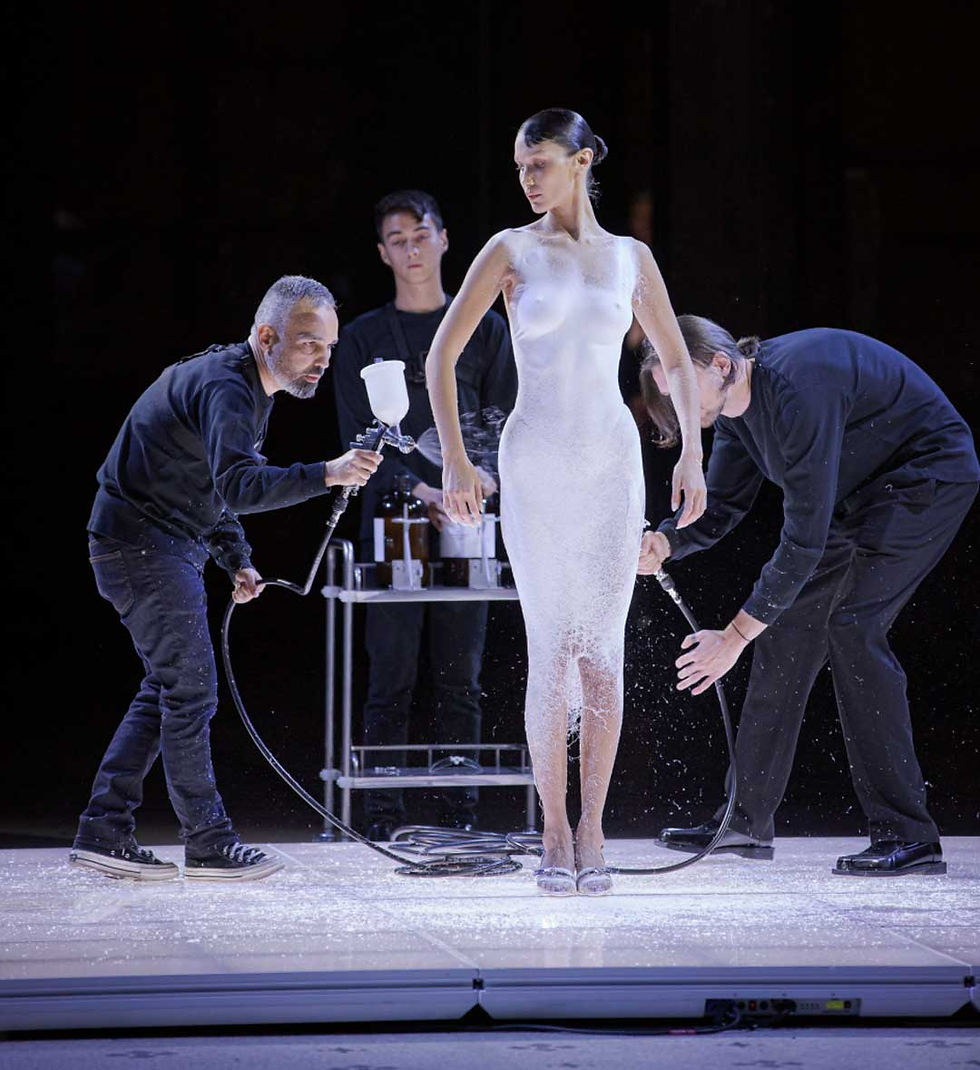
The show took place inside the Salle des Textiles at the Musée des Arts et Métiers in Paris. For the finale, Bella Hadid walked onto the runway wearing only minimal undergarments before stepping onto a small platform. A team from Fabrican surrounded her with spray guns, coating her body in a white liquid fiber that gradually transformed into a wearable dress.
In just under 15 minutes, the substance solidified into a seamless, non-woven textile. Coperni’s head designer then stepped forward to cut, shape, and drape the dress directly on Hadid — turning the technical demonstration into a tailored couture moment.
How the Spray-On Fabric Works
The material used comes from Fabrican, a technology invented in 2003 by Spanish scientist and designer Manel Torres. The liquid mixture contains natural and synthetic fibers — cotton, wool, mohair, nylon, or cellulose — suspended in a polymer solution.
When sprayed, the solvent evaporates instantly, leaving behind a soft textile with a suede-like finish. The result is a fabric that can be:
worn again,
washed,
repaired,
and even recycled.
This process challenges traditional textile production by merging chemistry, fashion innovation, and performance art into a single gesture.
A Viral Moment in Fashion History
Within 48 hours, the event generated $26.3 million in media impact value, according to Launchmetrics. Most of this originated from social media, where audiences compared the performance to iconic fashion moments, including:
Alexander McQueen’s Spring/Summer 1999 show, where robotic arms spray-painted a dress,
Hussein Chalayan’s 2016 dissolving garments,
Maison Margiela’s melting ice accessories that stained clothing as they dripped.
Coperni’s presentation continues this lineage — where the runway becomes a multidisciplinary platform for innovation.

Beyond the “Gimmick”: Innovation or Performance Art?
Reactions to the show were mixed. Some critics described it as theatrical and superficial, while others called it “fashion history.” Regardless of opinion, the moment captured something deeper: the ongoing transformation of fashion as a field where science, technology, and performance intersect.
The spray-on dress demonstrated:
new material possibilities,
sustainable future applications,
experimental couture processes,
and the role of fashion in technological storytelling.
For designers, technologists, and creators alike, it marked a glimpse into the future — one where garments may no longer be sewn but grown, sprayed, or engineered.
Where Fashion Meets Innovation
The Coperni × Fabrican moment reveals how fashion continues to evolve beyond tradition. It merges:
industrial design,
material science,
craft,
and live performance.
For designers and creatives, it’s a reminder that innovation doesn’t have to replace beauty —
it can amplify it.
The dress was not just worn.It was born in front of an audience.
Written by Otávio Santiago, a designer shaping narratives through motion, graphics, and 3D form. His approach merges emotion and precision to craft timeless visual identities and experiences.




Comments